

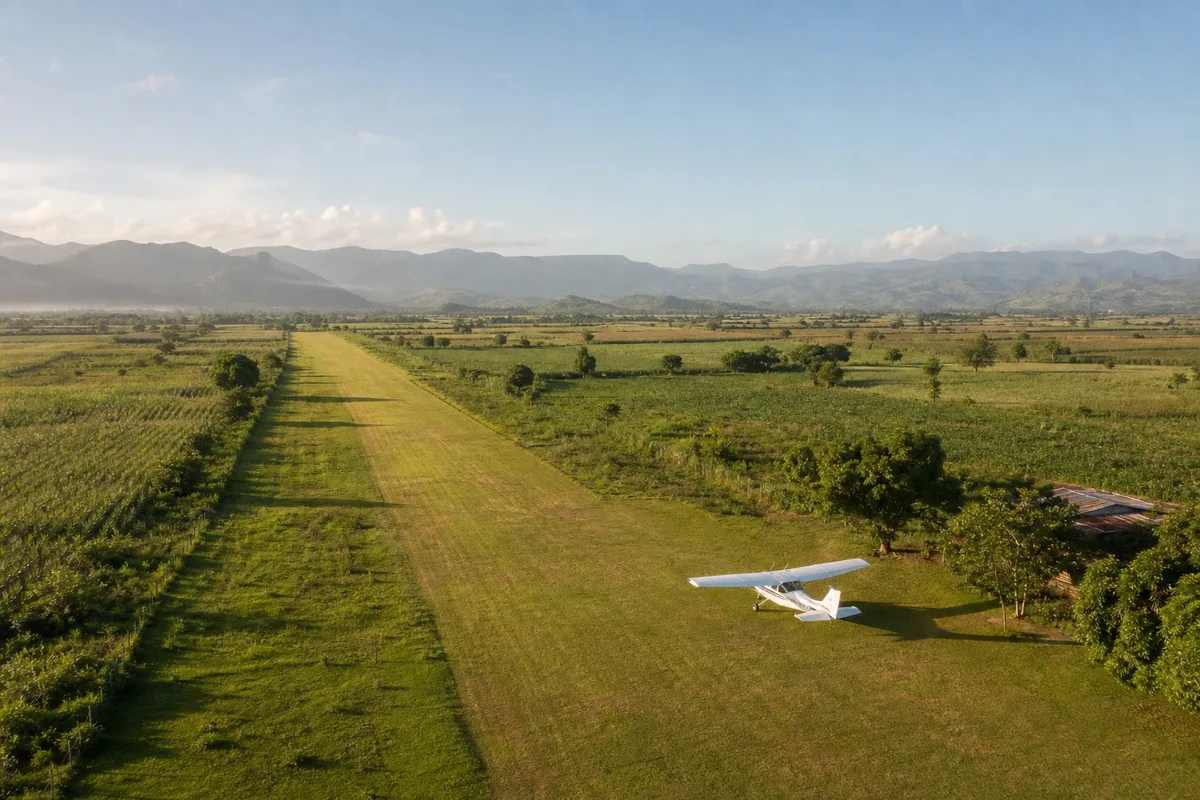
Dajabón Airport is not a smaller version of Punta Cana Airport. It is a domestic aerodrome serving the Dominican Republic’s northwest border region, with no dependable public airline timetable and none of the terminal infrastructure travellers expect at PUJ or SDQ. The official Dominican aeronautical publication identifies it as Dajabón (MDDJ). If a charter, private or official flight is using the field, confirm the movement directly with its operator before arranging the road pickup.
Dajabón Airport at a glance
| Official listing | Dajabón domestic aerodrome |
|---|---|
| ICAO code | MDDJ |
| IATA code | No IATA code is shown in the official Dominican AIP entry; use MDDJ and the full airport name |
| Location | Dajabón Province, northwest Dominican Republic |
| Operation | Domestic aerodrome; confirm each private, charter or official movement with its operator |
| Published runway | 07/25, grass, 1,700 × 50 metres |
| Published operating hours | HJ, meaning daytime operation |
| Responsible authority | Dominican Republic Air Force, as listed in the national AIP |
The Dominican Republic Aeronautical Information Service is the primary source for the airfield’s status. Its published domestic-aerodrome table lists MDDJ at 19°33′49″N, 71°40′51″W, an elevation of 43 metres (141 feet), a grass runway and daytime hours. These are aeronautical planning facts, not a promise that a passenger flight, terminal service or ground handler will be available on a particular date.
Dajabón is beside the international border with Haiti, but MDDJ should not be treated as an international passenger gateway. International travellers normally complete immigration and customs at the airport or land border through which they enter the Dominican Republic. A domestic or private onward flight to MDDJ does not replace those entry requirements.
Before you fly to MDDJ
- Confirm that the flight is real and operating. Ask for the aviation operator’s name, aircraft type, reporting location, planned arrival time and a contact who can confirm same-day changes.
- Use MDDJ in the itinerary. Search results may show unofficial or legacy three-letter codes. The official Dominican aeronautical material identifies the airfield by ICAO code MDDJ.
- Ask about the grass runway and daylight restriction. The pilot and operator—not the passenger or transfer provider—decide whether conditions permit the operation.
- Check baggage by weight and dimensions. Small aircraft commonly have tighter limits than scheduled international flights. Confirm what the aircraft accepts before choosing a road vehicle.
- Send the complete ground itinerary. Include the flight or aircraft reference, lead passenger, working phone number, passenger count, every bag and the precise final address.
If you enter the Dominican Republic from abroad before continuing to Dajabón, complete the official Dominican Republic e-Ticket for the international entry and exit journey. Do not pay an intermediary: the government form is free. Your airline or border authority remains the source for the documents required for your nationality and itinerary.
Arriving at Dajabón Airport and meeting your driver
There is no large arrivals hall, baggage carousel or run of resort sales desks. The handoff is closer to a coordinated airfield pickup: the driver needs the actual aircraft movement, lead-passenger name and a working contact for the operator or passenger. Keep the driver’s number available offline because mobile data is not a substitute for a meeting plan.
Identify the driver through the name, vehicle or booking reference in your confirmation. If the aircraft lands earlier, later or at a different facility, contact the transport provider directly. A change made with the pilot or flight operator does not automatically update the road vehicle.
The nearby border creates another possible misunderstanding. A pickup at MDDJ is a domestic ground-transfer arrangement. It does not include immigration processing, permission to cross into Haiti, a cross-border vehicle movement or a pickup at the Dajabón–Ouanaminthe border post unless those services and formalities have been expressly confirmed in writing.
Runway, operating conditions and passenger facilities
The national AIP describes runway 07/25 as a 1,700-by-50-metre grass strip and lists the airfield for HJ, or daytime, operation. Travellers should not translate those specifications into their own go/no-go judgement. Weather, surface condition, aircraft performance, operational permissions and current notices are matters for the pilot and aviation operator.
Do not assume that MDDJ provides airline check-in counters, a lounge, restaurant, ATM, currency exchange, rental-car desk, jet bridge or scheduled public transport. Before travelling, ask the operator where passengers report, what shelter and assistance are available, how bags will be handled and whether a companion may enter the operating area. Passengers needing reduced-mobility assistance should agree on the complete aircraft-to-vehicle procedure in advance.
Time-sensitive notices can supersede published background information. Flight operators should check the current AIP and NOTAMs; passengers should seek a fresh operational confirmation from the operator rather than trying to interpret aviation notices themselves.
Ground transport from Dajabón Airport
The practical options are different from those at a busy international terminal.
Recommended
Pre-booked private transfer
A vehicle is assigned to the confirmed aircraft movement, group and luggage, with the final address agreed before the trip. This is the most predictable option when the airfield does not have a regular stream of arriving passengers.
- Pickup tied to the actual operation
- Vehicle selected for passengers and bags
- Route, stops and border-area limits agreed in advance
Self-drive
Rental car
A rental car may suit a longer northwest stay, but collection at the aerodrome should never be assumed. Confirm the actual handoff location, insurance, deposit, road coverage and return arrangements with the rental company.
Taxi, ride-hailing and public transport
Do not build the itinerary around walk-up availability. A small airfield handling individual movements is not comparable with a scheduled terminal taxi rank. Local transport may exist in the city, but the pickup point, vehicle capacity and price should be settled before the aircraft departs.
Where travellers go from MDDJ
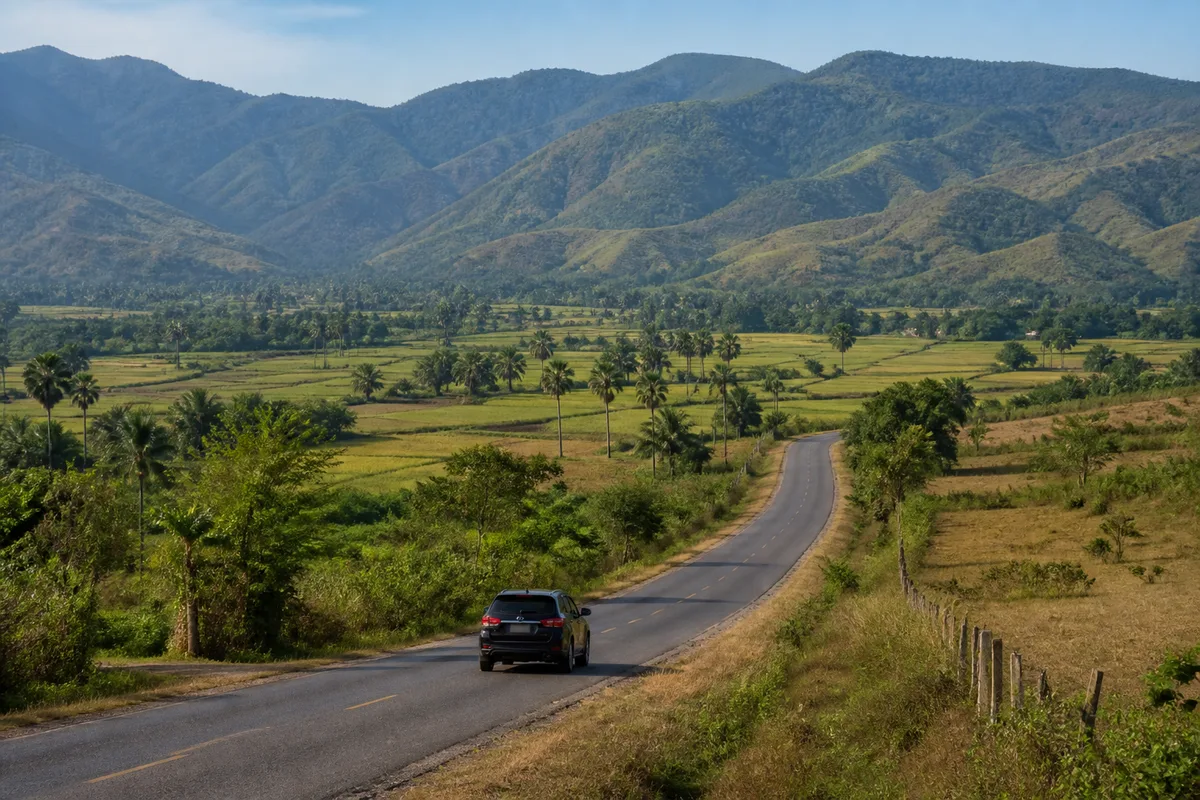
Dajabón city is the immediate service centre, while Loma de Cabrera, Restauración, Monte Cristi, Santiago and other northwest destinations are separate road journeys. The final property, road conditions, planned stops and any border-related restriction determine the route. The table deliberately avoids a universal drive time: a map estimate is not a service promise.
| Destination | What to confirm | Planning |
|---|---|---|
| Dajabón city | Hotel, residence, business, government office or exact meeting point | Request a local quote |
| Loma de Cabrera | Town address or rural property entrance and a reachable local contact | Request a route quote |
| Restauración | Complete mountain-area address, map pin and road-access notes | Request a route quote |
| Monte Cristi / Manzanillo | Hotel, port, marina, business or community address | Northwest transportation |
| Santiago / Cibao Airport (STI) | City district or both confirmed flight arrangements for an airport connection | Santiago transportation |
| Dajabón border area | The Dominican-side meeting point and the separately confirmed legal border-crossing plan | Discuss the itinerary first |
For an accurate quote, send the full address rather than a province or attraction name. Include every stop, the time by which you must arrive, passenger count, suitcase count, child-seat needs and any item such as a cooler, equipment case or mobility aid.
What determines the transfer price
A Dajabón quote begins with the positioning and route, not a generic airport tariff. The main variables are the exact pickup confirmation, distance, time of day, vehicle class, luggage volume, additional stops and whether the trip is one way or return. A short city drop-off and a vehicle continuing to Santiago or the coast are different jobs.
Compare written quotes on the same basis: private or shared, per vehicle or per person, what waiting is included, how a changed aircraft time is handled, whether tolls or extra stops are included and how payment is made. Prestige will need the actual operation and final address before it can provide a route-specific price.
Baggage, equipment and child seats
The aircraft restriction comes first. Confirm the permitted weight, bag count and dimensions with the flight operator, then give the road-transfer provider the load that was accepted. A vehicle with enough passenger seats may still be too small for several hard cases or bulky equipment.
- Hard flight and production cases: give dimensions and identify items that cannot be stacked.
- Coolers, tools and sporting equipment: list each item separately rather than calling it “extra luggage.”
- Pushchairs and mobility aids: state whether they fold and whether the passenger can transfer to a standard vehicle seat.
- Child seats: request them in advance with the child’s age, height and weight so availability and the suitable type can be discussed.
Planning travel in the Dajabón border region
Dajabón and Ouanaminthe face each other across the Dominican–Haitian border, but proximity does not make the crossing an ordinary hotel transfer. Immigration rules, customs controls, border opening arrangements, security conditions, permitted vehicles and traveller documentation can change. Confirm current requirements with the relevant government authorities and obtain written confirmation from any transport provider involved.
A Dominican private transfer should be planned to a precise point it is authorised to serve. If the itinerary involves Haiti, define the Dominican-side drop-off, the legal crossing process and any onward transport as separate steps. Never assume that a driver, rental car or insurance cover may cross the border merely because the road continues on the map.
For travellers coming from an international flight, STI or POP may offer a simpler scheduled-airline itinerary followed by a longer road transfer. MDDJ makes sense only when a specific domestic or private operation is confirmed and genuinely improves the complete journey.
Planning the return flight
Reconfirm the aircraft movement, daylight operating plan, surface suitability, reporting location and baggage limit with the aviation operator. Agree on the vehicle pickup point and route buffer before departure day, especially from a rural property or mountain community. If weather or the operator changes the plan, notify the driver directly.
Frequently asked questions
Does Dajabón Airport have regular commercial flights?
Do not assume a scheduled passenger service. MDDJ is a domestic aerodrome used for individual private, charter, official or other approved movements. Confirm the exact operation directly with its provider.
What is the code for Dajabón Airport?
The official Dominican aeronautical publication identifies the airfield by ICAO code MDDJ. It does not show an IATA code in the domestic-aerodrome entry, so use MDDJ and the full airport name.
Is Dajabón Airport international?
No. The official AIP lists it as a domestic aerodrome. Its location near Haiti does not turn it into an international passenger gateway or border-processing facility.
Is the runway paved?
No. The published AIP entry describes runway 07/25 as grass, 1,700 metres long and 50 metres wide. Current suitability is for the pilot and flight operator to confirm.
Can I arrive at night?
The AIP lists HJ, meaning daytime operation. Confirm the specific schedule and any current restriction directly with the aviation operator.
Will there be taxis or rental cars waiting?
Do not assume walk-up availability at a small domestic aerodrome. Arrange the transfer or rental handoff before departure and obtain the meeting instructions in writing.
Can a Prestige vehicle cross into Haiti?
Do not assume that a Dominican transfer vehicle can cross an international border. Any cross-border itinerary requires separate confirmation of immigration, customs, vehicle, insurance and security arrangements. Request a plan before booking.
What should I send for a transfer quote?
Send MDDJ, the operator or aircraft reference, arrival date and time, lead passenger, working contact number, complete destination, passenger count, every bag, child-seat needs and all planned stops.
Need transport from or to Dajabón Airport?
Send the confirmed aircraft movement, complete address, passenger count and luggage details for a route-specific plan.
Get an exact transfer quoteFacts last checked 15 August 2026. Primary references: Dominican Republic Aeronautical Information Service and its published domestic-aerodrome data; IDAC AIP information; and the official Dominican Republic e-Ticket.
Found an inaccuracy or outdated detail? Please contact us so we can review and correct it.